
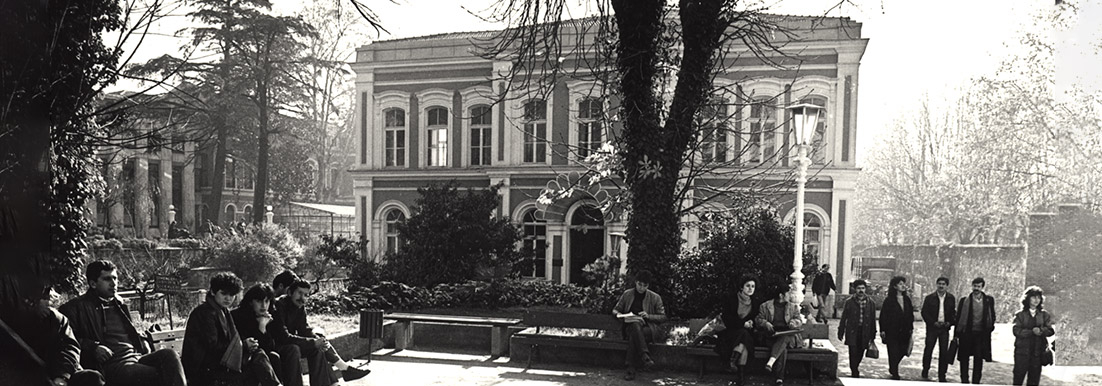
The Department of City and Regional Planning, established in 1982 within the Faculty of Architecture at Yıldız Technical University, traces its roots back to a two-hour urban planning course offered as part of the Department of Architecture’s curriculum in the 1940s. In the Department of Architecture—which began offering instruction as a separate department during the 1942–1943 academic year at the Istanbul Technical School, the predecessor of YTÜ—urban planning courses were first taught by Behçet Ünsal and Adnan Kuruyazıcı. In 1955, İrfan Bayhan joined the academic staff of the Istanbul Technical School (İTO) after graduating from the ETH Zurich School of Architecture, laying the groundwork for the establishment of the urban planning department.
The Istanbul Technical School was transformed into the Istanbul State Academy of Engineering and Architecture (İDMMA) in 1969, and under the chairmanship of İrfan Bayhan, the faculty—comprising Ergun Taneri, Hüseyin Kaptan, Emre Aysu, and Semra Atabay established the Department of Urban Planning and Design within the Department of Architecture. The 1970s marked a period during which the discipline of urban planning developed as a separate department within the architecture departments at Istanbul Technical University and the State Academy of Fine Arts. This development was driven by the growing recognition of the importance of planning in the face of problems caused by rapid urban growth, as well as the experience gained through competitions for urban plans. During these years, all three universities would establish an “Institute of Settlement Sciences and Urban Planning,” and master’s and doctoral programs in “Urban Planning” would begin.
During this period, Rıfkı Arslan, who had left the Economic and Social Studies Group Directorate of the Greater Istanbul Master Plan Office, and Necdet Vidinlioğlu, who had left the Regional Planning Department of the Ministry of Urbanization and Housing, began working at the Urban Planning Chair of the Architecture Department at İDMMA in 1975. This faculty, specializing in economics and law, played a decisive role in strengthening the socio-economic focus of the Department of City and Regional Planning—which would be established in 1982—and in shaping YTÜ’s unique educational model. Starting in 1975, Yalçın Ünal, Zekai Görgülü, and Hüseyin Cengiz joined the Department of Urban Planning; and Ayşe Nur Ökten—who held bachelor’s and doctoral degrees in the social sciences—joined the Department of Social Sciences, further strengthening the structure of the urban planning discipline. Following the merger of Kadıköy DMMA with Yıldız University, Zekiye Yenen joined the faculty.
These years marked a period of increased publications and conferences that supported the master’s programs in urban planning offered at three universities in Istanbul and the urban planning institutes. The Institutes of Settlement Sciences and Urban Planning at ITU, DGSA, and İDMMA organized joint meetings and inter-institute committees. The factor that accelerated the establishment of City and Regional Planning Departments to offer undergraduate education during this period was Law No. 2547 on Higher Education, enacted on November 4,1981 and the “Decree Law No. 41 on the Organization of Higher Education Institutions,” issued on July 20, 1982, pursuant to this law. With these regulations, İDMMA adopted the name Yıldız University following the incorporation of the Işık, Vatan, Galatasaray, and Kadıköy Faculties of Engineering and Architecture into the university and the addition of the Faculty of Science and Letters to its structure. The Department of City and Regional Planning, along with the Department of Computer Engineering, was established in April 1981 pursuant to a decision by the IDMMA Board of Directors. Structured as two sub-departments and commencing education in the 1982–1983 academic year, the department appointed Prof. İrfan Bayhan as Department Chair and concurrently as Chair of the Urban Planning Sub-Department; while Assoc. Prof. Dr. Ergun Taneri was appointed as Chair of the Regional Planning Division. In 1983, Yüksel Dinçer; in 1984, Solmaz Tavşanoğlu, İclal Dinçer, and Tülin Tekne; and in 1985, Arzu Kahraman were appointed to research assistant positions in the department, largely completing the YÜ Department of City and Regional Planning’s faculty roster for this period. Until October 1987, the department chair and faculty members used rooms 205 and 209, located on the ground floor of the Faculty building; Necati İnceoğlu was appointed as a professor from Istanbul Technical University (İTÜ) to Yıldız University (YÜ) in 1985, and Orhan Göçer was appointed in 1986; Orhan Göçer served as department chair during the 1991–92 academic year.
1986 was the year Yıldız ŞBPB graduated its first class. Among these graduates, Özdemir Sönmez, Müjde Saatçi, Berna Dikçınar, Ayfer Gül, and Oya Akın, who had begun their master’s programs, were appointed to the department’s research assistant positions in 1987; Betül Şengezer began her doctoral studies at YÜ and joined the department’s faculty. Ali Kılıç and Ercan Koç were appointed to the department’s faculty in 1987, and with the addition of Atakan Gül and Fatih Yaren in 1988, followed by Zeynep Enlil, Hülya Döşer, and Dikmen Uğuz in 1989, the department’s faculty was strengthened by thirteen new faculty members within two years. The increase in the number of faculty members and students inevitably heightened the need for new facilities, and in early 1987, the department moved to its current location on the second floor of the Faculty building, which had been vacated by the Department of Civil Engineering. The university, established as Yıldız University in 1982, was reorganized as Yıldız Technical University ten years later by Law No. 3837 dated July 3, 1992.
The first decade following these years was a period during which efforts were made to complete the department’s academic and institutional infrastructure and to review its educational programs. In 1987, the department’s founder, İrfan Bayhan, stepped down from his position as department chair, and in 1989, he retired due to reaching the mandatory retirement age. Established through the donation of his personal library to the department chair’s office—now known as the “City and Regional Planning Department Information and Documentation Center”—the center would gradually expand with donations from other faculty members, and this center—which serves as an archive of the department’s graduation projects and theses and is open to the public—will be managed by Nilgül Yılmaz.
Following the graduation of the first classes from YTÜ in 1986 and from İTÜ and MSÜ a year later, the number of urban and regional planners in Istanbul began to grow, and their efforts to establish the Istanbul Branch of the Chamber of Urban Planners gained momentum in the 1990s. With the support of YTÜ, the Istanbul branch was established in 1991, with Özdemir Sönmez serving as its founding president.
The 2000s were the years when faculty members who had completed their doctorates or begun their doctoral studies during the Department’s early years began gradually training the generations that followed them and handing over their responsibilities to them. During this period, in addition to continuing the Department’s educational programs and conducting research and publication activities, faculty members organized numerous national and international conferences.
As of
2026, the YTÜ Department of City and Regional Planning faculty consists of 5 professors, 13 associate professors, 3 assistant professors, 1 instructor, and 11 research assistants, with 2 administrative staff members working in the department.
Following a process of educational
monitoring and program renewal that began in the 2000s, the undergraduate curriculum was revised in 2003 and the graduate curriculum in 2004, with the new curricula taking effect. The master’s degree program, offered in two tracks—Urban Planning and Landscape Planning—has been organized into five distinct programs: Urban Conservation and Planning, Urban Regeneration and Planning, Urban Space Organization and Design, Regional Planning, and Applied Urban Science and Urban Innovation; the curriculum for the Urban Planning doctoral program was also reviewed. As part of the efforts to align with the Bologna Education System carried out across all departments at YTÜ during the 2010–2012 period, the Department’s undergraduate education was revised in 2018 and 2024.
As of the Spring 2025–2026 semester, the Department of Urban Planning at YTÜ offers undergraduate education to 392 students and graduate education (master’s and doctoral programs) to 149 students. The department, which graduated its first class of 11 students in 1986, has produced a total of 1,696 undergraduate graduates over the course of 43 years.
As of
2025, the YTÜ Department of City and Regional Planning has established a structure that brings together faculty members from diverse fields of expertise and different academic traditions. This structure draws inspiration from the Department of City and Regional Planning—which was founded by faculty members from diverse scientific fields who established the Chair of Urban Planning and Projects and the Chair of Social Sciences—and is built upon this foundation of diversity. It is our hope that this diversity will continue to be maintained in harmony in the future.
"The Department of City and Regional Planning: After 40 Years, 1982–2022" Book